01
The right email is hard to find
A document check sits between a berthing report and a phishing mail. Staff read every message to decide what it needs, and a request that is missed is never checked.
Shipping document verification · from inbox to discrepancy report
A documentation desk gets hundreds of emails a day: document checks, new shipping instructions, invoice queries, notices and spam. Xveris reads all of them, compares every draft bill of lading with its shipping instruction field by field, and tells you what needs a person — with the evidence.
The problem
01
A document check sits between a berthing report and a phishing mail. Staff read every message to decide what it needs, and a request that is missed is never checked.
02
Shipper, consignee, notify party, both ports, container count and gross weight, across two documents, hundreds of times a week. One missed consignee change releases cargo to the wrong company.
03
“Port of Loading” on the SI is “Load Port” on the BL. Values arrive as text, Excel, Word, PDF and scans, some of them blank or unreadable.
Inside
The whole inbox on one map — all 520 emails, from the last run. Every dot is an email, grouped under the queue it belongs to.
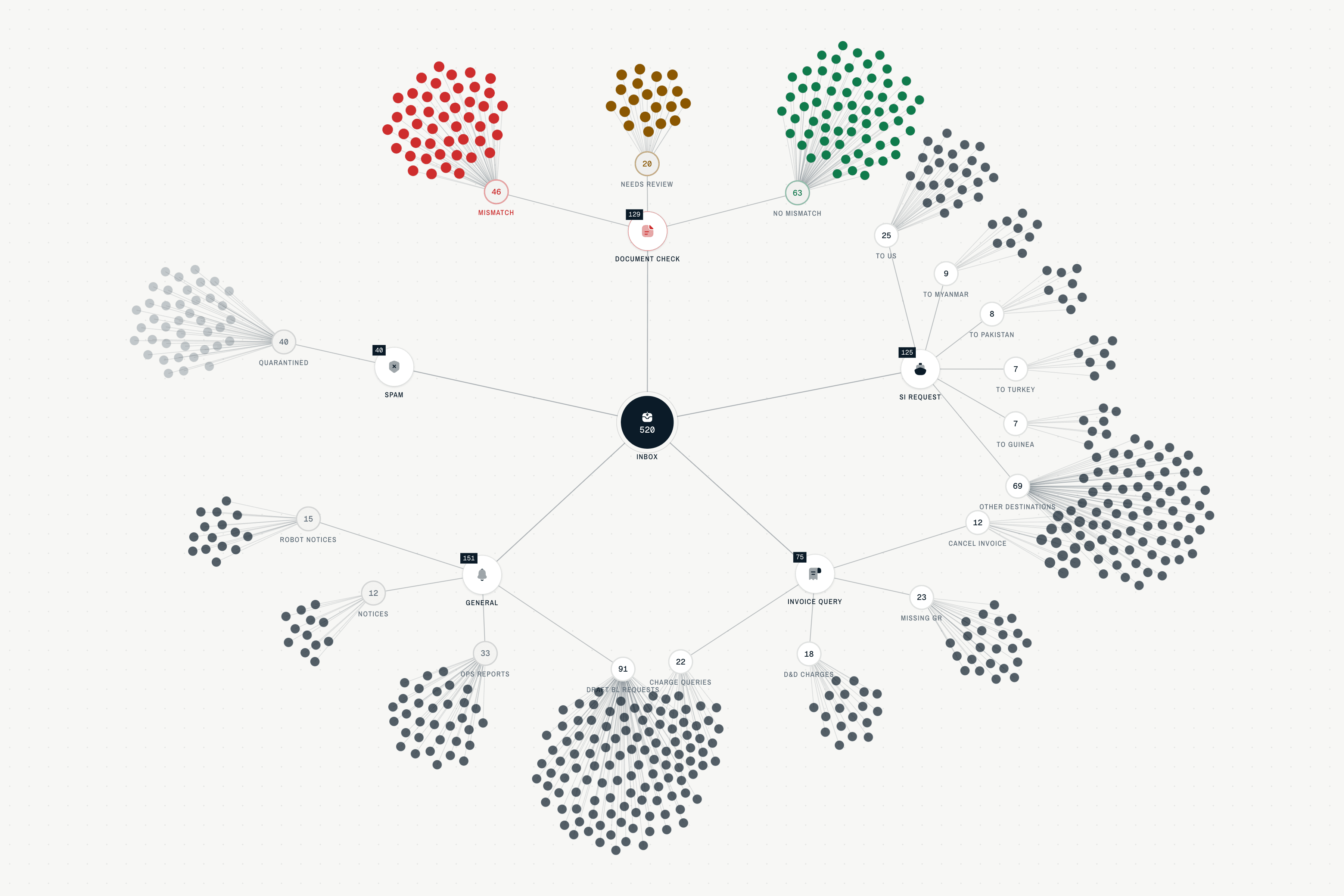
Mismatch
46
a field differs from the SI
Needs a person
20
missing, unreadable, wrong document or blank
Verified
63
all seven fields matched the SI
In the app the map is live: pan, zoom, replay the run, and open any email down to its seven fields.
How it works
Gmail or a mail store, with every attachment: text, Excel, Word, PDF and scans.
Read-only
Claude classifies each email; a rule engine checks the same one. Disagreements go to a person.
AI + rules
Parties, both ports, containers and gross weight, matched by meaning, not by label.
Any layout
Plain code judges SI against BL, so formatting never becomes a false alarm.
Deterministic
Missing, unreadable, wrong or blank goes to review with its evidence, and the report updates.
Human in the loop
FAQ
Ready to see it on real mail? Open the dashboard, or connect a mailbox and let Xveris read a fortnight of it.
Claude classifies every email and explains why, reads scanned PDFs with vision, and maps layouts the parser has not seen. It never decides that two values match: the seven-field comparison is deterministic code, so the same documents always give the same verdict.
The email goes to review with the reason — missing attachment, unreadable file, wrong document type, or a blank value — and the evidence. A person confirms it or types what the document really says, the comparison runs again on their values, and the report updates.
Gmail access is read-only and covers recent mail and its document attachments. The token is kept encrypted in your own browser, never in our database, and disconnecting removes it. Nothing is ever sent or deleted on your behalf.
Plain text, Excel, Word, PDF with text, and image-only scans through vision. A file that cannot be opened is reported as unreadable instead of being skipped quietly.
Values are normalised before comparison: 131,058 KG equals 131058, a repeated city-state equals the city, and a missing port code is formatting, not a discrepancy. A wrong port is still caught, because the name decides, not the code.
Yes. The discrepancy report lists every check with both values side by side, the export produces the organisers' submission file, and the whole pipeline runs from the command line with the tests.